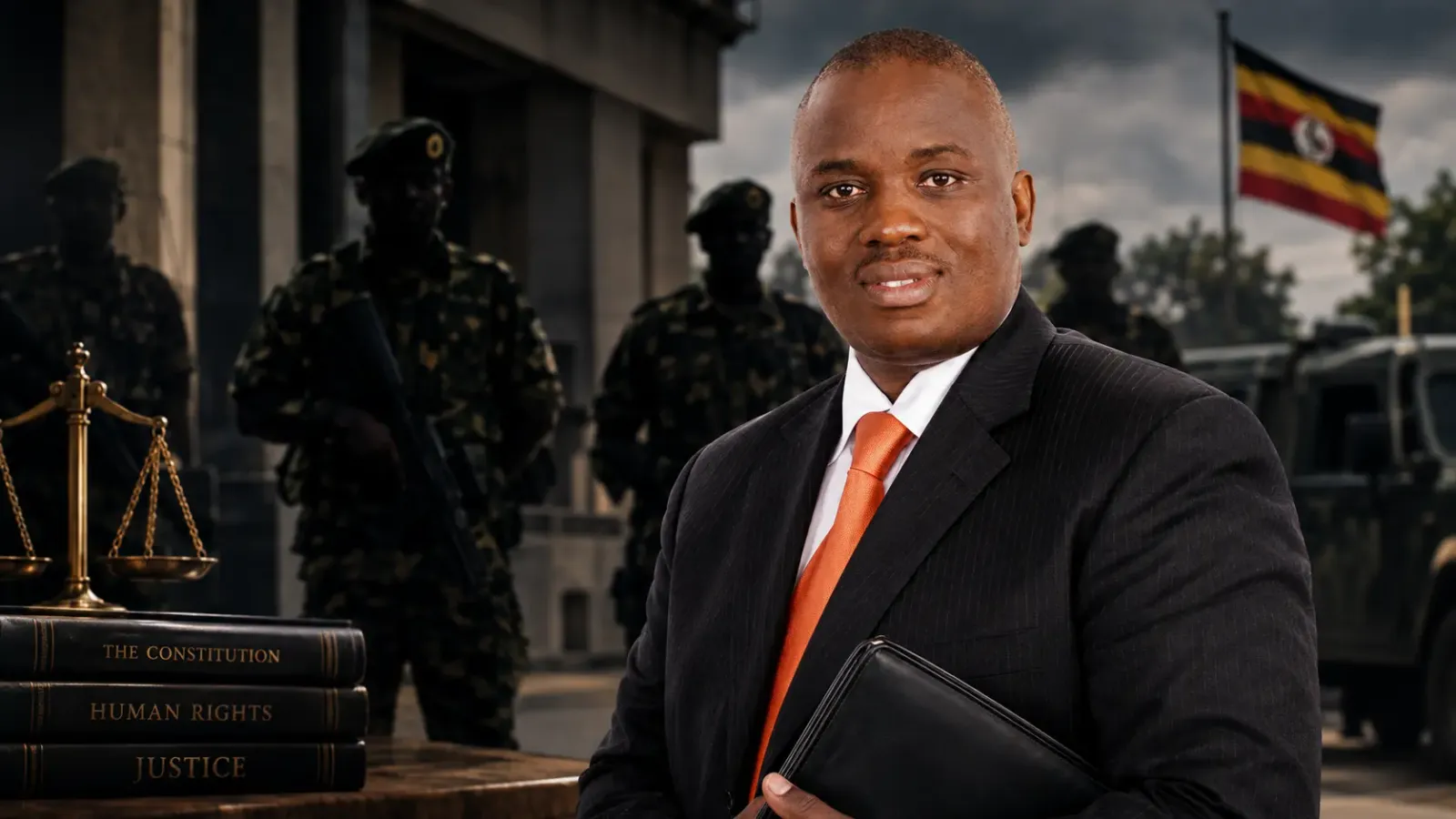
At approximately five in the morning on June 15, 2026, armed security personnel descended on the home of Erias Lukwago in Kampala. They reportedly sealed off the surrounding area, scaled the compound wall and took away the prominent opposition lawyer without presenting an arrest warrant. For more than 48 hours, his whereabouts remained unknown.
Lukwago was not an unknown figure dragged into a public controversy. He was a lawyer, a former Lord Mayor of Kampala and a political opposition leader who had spent years challenging those in power through legal and political channels. At the time of his seizure, he was representing opposition leader Kizza Besigye and preparing to serve legal documents on General Muhoozi Kainerugaba, Uganda's Chief of Defence Forces.
Then came the public declarations. Kainerugaba appeared to acknowledge responsibility for Lukwago's detention, claiming to hold him in a basement and sharing a photograph in which the lawyer appeared blindfolded. The general also threatened to inflict "hurt and pain" on him.
The episode raises a question that should trouble anyone who believes the law must apply equally to the powerful and the powerless: what happens when the person being challenged through legal proceedings commands the military forces that can seize the person challenging him?
A lawyer becomes the target
Lukwago's legal work had brought him into direct conflict with Kainerugaba. He represented Besigye, a longtime opposition figure who had disappeared in Nairobi, Kenya, in November 2024 before reappearing in Uganda in military custody. Besigye's detention and prosecution had already provoked serious concerns about due process and the treatment of political opponents.
Lukwago was pursuing legal action concerning alleged threats against Besigye. His work placed him in the uncomfortable position of seeking accountability from one of the country's most powerful military figures.
The reported operation against him was therefore alarming not merely because of the manner of his arrest, but because of the circumstances surrounding it. A lawyer preparing legal proceedings against the army chief was seized by armed personnel, taken to an undisclosed location and publicly discussed by the very commander whose conduct he was challenging.
The sequence raises serious concerns about retaliation and the use of military power to intimidate legal opponents. Those concerns demand independent investigation, not dismissal.
A justice system cannot function properly if lawyers must fear that representing unpopular clients could expose them to detention, threats or humiliation. When legal representation itself becomes dangerous, the consequences reach every person who may one day need a lawyer to challenge an unlawful arrest, defend their freedom or demand accountability from a public official.
Public threats from the highest military office
The conduct attributed to Kainerugaba after Lukwago was seized makes the case particularly disturbing. Rather than limiting public comment while the circumstances of the detention were clarified, the general made statements about holding the lawyer and threatened him with pain.
These were not merely questions about military procedure. They concerned a senior commander publicly discussing a detained civilian in language that appeared to celebrate the prospect of punishment.
There is something deeply troubling about the spectacle of a powerful official appearing to turn another person's detention into a public demonstration of dominance. A person held in custody cannot freely leave, defend themselves in public on equal terms or control how their image is displayed. That imbalance makes the responsibility of those holding power especially serious.
If a military commander can publicly threaten a detainee without meaningful consequences, what protection remains for someone with fewer resources, fewer connections and no public platform?
The danger is not confined to the individual who is threatened. Such conduct can send a chilling message to lawyers, journalists, activists and ordinary citizens: challenging authority may bring consequences beyond the courtroom.
That is how intimidation can spread. One person's ordeal becomes a warning to many others.
From an undisclosed location to a prison cell
On June 17, Lukwago was transferred to a police station and brought before a court. He was charged with misprision of treason, an offence concerning an alleged failure to report treasonous activity. He denied the charge and was remanded to prison.
The formal appearance before a court did not erase the questions raised by the preceding two days. Nor did the existence of a criminal charge settle whether the initial seizure, the reported detention conditions or the public threats were lawful.
Due process is not a privilege reserved for people who enjoy the approval of those in power. It is most important when the accused is politically controversial, when the allegations are serious and when the authorities exercising power are themselves the subject of legal scrutiny.
Lukwago's health subsequently became another source of concern. Court proceedings were adjourned after prison authorities reported that he was undergoing specialised medical investigations and treatment. His lawyers sought his release on health grounds, but his legal struggle continued.
The human consequences of detention cannot be reduced to a charge sheet and a court date. Illness, uncertainty and separation from family can make an already difficult situation more distressing. The available reporting does not establish every detail of Lukwago's treatment, but the reported concerns about his health demanded serious attention from the authorities responsible for his custody.
The wider cost of fear
Lukwago's case is part of a broader pattern of reported military seizures of government critics in Uganda. Human rights organisations have raised concerns about people being taken to undisclosed locations, held without timely access to family or lawyers, and subsequently prosecuted.
Each case must be examined on its own evidence. But when similar allegations recur, they raise questions about institutional safeguards, accountability and whether security powers are being used to suppress dissent.
The implications are especially serious when the people affected include lawyers defending opposition figures. An attack on the independence and safety of legal representatives can weaken the ability of an entire society to challenge abuses through peaceful, lawful means.
The principles at stake are not complicated. Detention must have a lawful basis. Detainees must be treated humanely. Allegations must be tested through fair proceedings. Military authority must remain subject to the law.
These safeguards exist precisely because unchecked power can become destructive. Without them, a person's freedom may depend less on their legal rights than on whether someone powerful chooses to respect those rights.
Power must answer to the law
The reported seizure of Erias Lukwago presents a grave challenge to the principle that no public official stands above the law. A lawyer seeking legal accountability should not have to fear being taken away by armed personnel, held at an undisclosed location and publicly threatened by the military commander he intended to challenge.
The allegations surrounding Kainerugaba's conduct warrant independent scrutiny and meaningful accountability wherever wrongdoing is established. His military rank does not exempt his actions from examination, and a criminal charge against Lukwago does not remove the authorities' obligation to respect his rights.
The most disturbing question is what such an episode teaches the next lawyer who considers challenging a powerful official, the next journalist who investigates alleged wrongdoing, or the next citizen who believes the courts should provide protection against the misuse of authority.
If the answer is that they must first consider the risk of being seized, threatened or humiliated, then the damage extends far beyond one detention.
No office confers a right to cruelty. No uniform places its wearer beyond accountability. And no society can claim to uphold justice if the people who seek it must live in fear of those they ask the law to restrain.